Showing posts with label Luyengo Farm. Show all posts

Friday, 26 February 2016

National Disaster declared in Swaziland


The Marker for the bore-hole at Mpandesane 


Two conversations with Swaziland today: Mandla Mdluli, Diocesan Development Officer and Tiekie de Beer, Managing Director of Luyengo Farm.


Mandla Mdluli


Mandla says the Swazi Government have declared a National Disaster in the face of the on-going drought. “We have received a bit of rain in the past few days, still not enough to put to an end the current situation. In today’s  newspaper it is reported that “Water woes will last for the next six months in Mbabane”. Government is currently supplying water to 16 Counties mainly in the Lubombo and Shiselweni regions. I will tell you my experience that on January 20th I went to the wholesaler to quote for a 50kg bag of mealie meal. It was E292 and I went back on February 10th to buy it and the new price was E427. It is craziness.  The country will have over 60% loss in maize production which means we will have to import more than 150,000 thousand tons of maize, hundreds of farmers could loose their jobs, more than 50% of farmers will have their livelihoods wiped out.”


Tiekie de Beer


Tiekie agrees. “Most subsistence farmers couldn’t plant maize because of the dry ground. When a little rain came they planted their own seed, which will take too long to ripen. They couldn’t afford to buy quicker growing seed. So as bad as things are now, it will be much worse in April and May, when there will be no harvest. Some homesteads have planted cabbages, but it is still too dry for them to thrive. Half the country’s cattle are already dead; the maize harvest will only be 10% of what is required. People will starve, especially in the rural areas. Another complications that the sugar companies are not irrigating their crops and so government revenue will be seriously down when they are facing this crisis.”

Currently we are supporting the Diocese of Swaziland water project, which is ensuring that primary schools are supplied with water; we are also in the process of installing a bore-hole at Mpandesane, near Lavumisa, the poorest and driest part of Swaziland. (You may remember that the lake near the care point has dried up.)  We will support the diocese in whatever efforts they make to address the developing situation.


Luyengo Farm, thanks to Tiekie’s foresight in building the reservoir, has sufficient water to maintain production.

Thursday, 19 November 2015

Climate change and Swaziland


Jan writes from Swaziland:

"Reports from Swaziland  tell of serious drought and high temperatures.
In fact the situation here is described as a National Disaster.
The media has reported that many families are losing their cows while other families are not able to plant anything.

Most Swazis are subsistence farmers who grow maize and other crops to feed and raise their families while also rearing cattle to sell and educate their children. In Swazi tradition a man’s cattle reflects his wealth and most Swazis have a sentimental attachment to their livestock. It is for that reason that the death of cattle owing to drought is an emotional trauma to most families as well as financial ruin. A large proportion of rural households practice subsistence agriculture. About 66 percent of the population is unable to meet basic food needs, while 43 per cent live in chronic poverty.

We have to ask the question is this drought and lack of rain a Swazi problem and are they the ones who caused it?   

“Last month was the hottest October in modern history and the first ten months of the year have also been at record levels, US government scientists said this afternoon. (18 November)
The latest data means that 2015 is firmly on pace for being the most scorching since 1880, as global warming concerns mount ahead of key climate talks in Paris later this month.
October marked the sixth month in a row that heat records were shattered worldwide, said the monthly report by the US National Oceanic and Atmospheric Administration (NOAA).
"The globally averaged temperature over land and ocean surfaces for October 2015 was the highest for October since record keeping began in 1880," said NOAA.”

The situation in Malkerns:

The average monthly maximum temperature for
August:                  23.8C⁰
September:           25.4C⁰
October:                25.4C⁰

Actual maximum average temperature in 2015 measured at the farm in Luyengo:
August:                  29C⁰
September:           29C⁰
October:                36C⁰

The average monthly rainfall in Malkerns for:
August:                  20mm
September:           44mm
October:                98mm

Actual rainfall measured at Luyengo farm for:
August:                    6mm
September:           12mm
October:                38mm

The situation in the Makerns Valley is exaggerated by the ongoing repairs to the canal, necessitating periodic closure.

I went to see the very origin of the canal at the Usuthu river, 12 km from the farm. The river has practically no flow. Normally 50% of the water from the river is directed towards the canal. This canal feeds the entire Malkerns valley, all farms, all households and all businesses. The latest rationing proposals include the complete closure of the canal for periods of 2 weeks, that is if some rain will fall, otherwise there will be no water at all from the canal. At the moment the position is close to catastrophic. The farm is alive, but only thanks to the reservoir, and Tiekie’s careful rationing strategy."

Please support the Diocese of Swaziland as it continues to serve the people of Swaziland in these difficult days.

Friday, 21 August 2015

Luyengo Farm: better than ever!

The new fine seed planter


Walking over the fields of Luyengo Farm today it’s hard to imagine what it looked like during the devastating hailstorms of December 2014. Hail in Swaziland comes in a range of sizes from frozen pea to golf ball. Pockmarked cars are a common sight. The hail damaged mature cabbages and killed seedlings. It separated the tops from carrots and beetroot. It left mud that overflowed the tops of wellies. As well as destroying the crops in the field it made planting impossible and so affected the farm for several months.


Carrots ready for delivery

Today the farm looks magnificent. 8 hectares are under vegetables - soon to rise to 12. Early in the morning it is a hive of activity - picking in the fields, washing vegetables and packing in a variety of sizes and quantities, including microwave-ready packs, loading the truck, the tata and trailer and even Tiekie’s car to get the orders out. The staff are busy and happy, supervised by Adolf, the new foreman, Vuzile who’s in charge of the pack shed, Nomcebo who looks after orders and admin, and standing in the centre Tiekie, directing operations.


Luyengo Farm pork chops
Tiekie's beetroot & carrot washer


With recent investment in new machinery, including a fine seed planter, and the farm achieving ever higher yields, the future looks bright. Plans are afoot to increase the piggery to 30 sows later this year - the current pigs can’t eat all the vegetable waste produced.


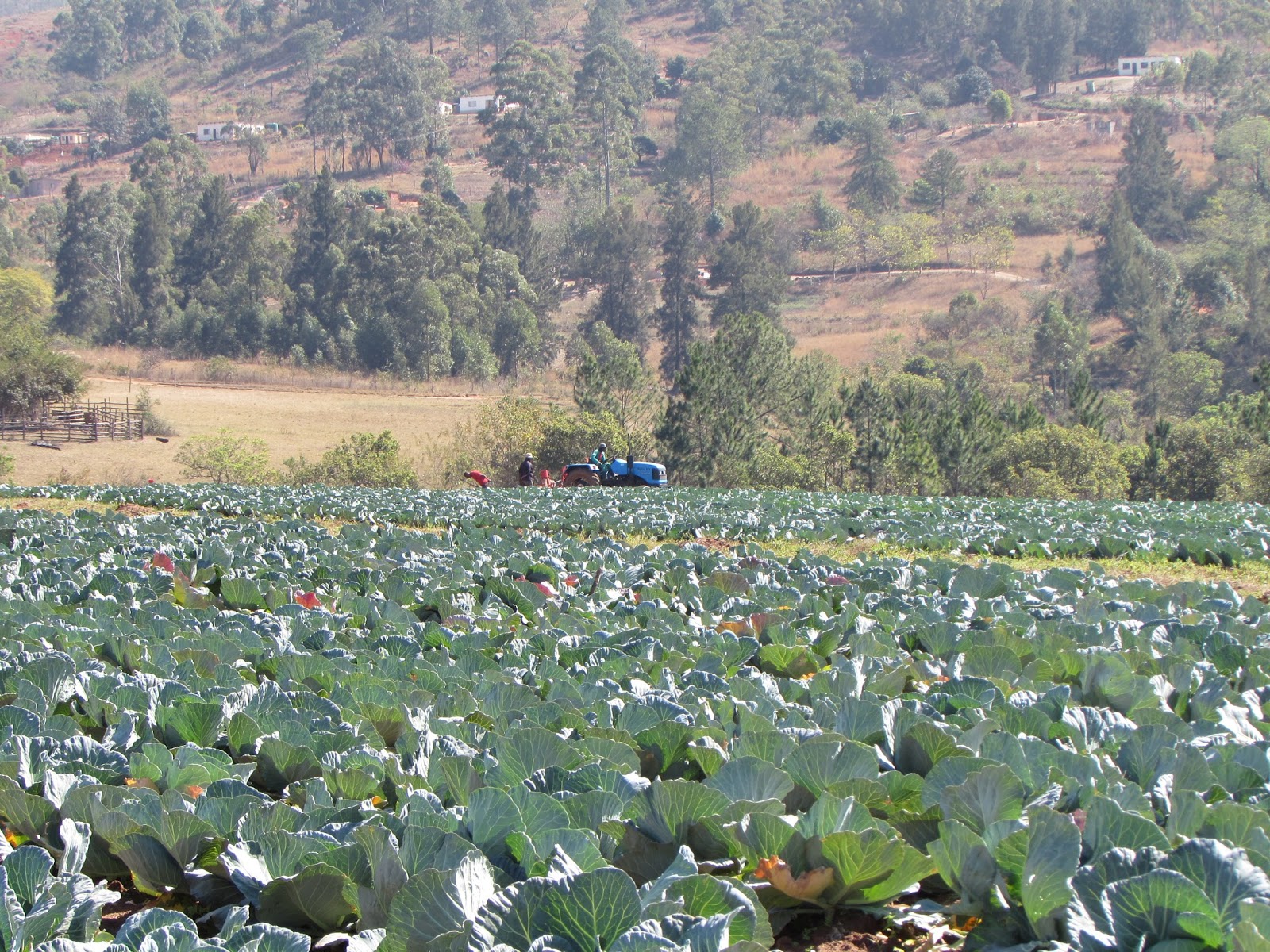
Cabbages on Luyengo Farm
Just today we heard that the carrot washer, sponsored by Limerick Diocese and built by students John and Brenda from Tralee IT, has left Durban by train and will arrive in Swaziland over the weekend. Unloading is scheduled for Monday afternoon - photos will follow!

Monday, 10 June 2013

This week at Luyengo Fresh Produce: The dam


We planted 5000 cabbage seedlings and harvested cabbage and carrots this week.
The beans and butternuts recovered well after the treatment Tiekie gave them after the hail damage.
Average max temp this week on the farm: 24°C
Average min temp this week on the farm: 7°C
Rainfall Averages 2013 to Date
January     169mm 270mm
February 140mm 180mm
March 100mm 167mm
April 70mm 140mm
May          24mm 110mm
June 10mm
“We finished the dam wall this week and we only have to do the concrete structures inside the dam. I was very worried one morning when I found water inside the dam. My argument is if water can leak in it can also leak out. I had a professional geologist on site and he assured me that that was not too much of a problem. The material that I used for the wall is more of a worry to him, however he feels that I over compensated with the thickness of the dam wall and the compaction and that is reassuring to him,” says Tiekie. 

If you are filled with pride, then you will have no room for wisdom. ~ An African proverb


Friday, 7 June 2013

This week at Luyengo Farm


We planted 4000 cabbage seedlings and beetroot this week and harvested cabbage and green mealies. We are looking forward to harvesting our carrots next week.
The Luyengo area was hit by a storm that brought us 110mm of rain over the past weekend. The heavy rain was accompanied by some hail which damaged some of our crop, mostly the beans and butternuts.
Average max temp this week on the farm: 25°C
Average min temp this week on the farm: 8°C
Rainfall Averages 2013 to Date
January 169mm 270mm
February        140mm 180mm
March         100mm 167mm
April           70mm 140mm
May          24mm 110mm
June          10mm
The dam building is in full swing but the unusually heavy rain of 110mm in one weekend in a month when the average rainfall is 24mm, has delayed our dam building. No work on the dam was possible this week. 
However towards the end of the week the 12 ton compact roller was able to do some work and from next week we will bring in the heavy equipment like the excavator and 10 ton tipper truck.
While we were debating whether we could save the paw-paw / papaya tree that stood on the brim of the new dam or not, nature came along and made that decision for us. The Swazi’s consider a fruit tree food and always wish to keep it but it would have been difficult given its position. Then last weekend the storm and hail came past and knocked that tree down. 

Wise words from Southern Africa: Money can’t talk, yet it can make lies look true.

Heloise


Sunday, 12 May 2013

This week at Luyengo Fresh Produce


The TLB in action on the dam site


We planted 4000 cabbage seedlings and beetroot this week and harvested cabbage and green mealies.
Our soil report showed that the pH of the soil is very low and we need to apply a huge amount of lime to adjust this. On some areas we have to add as much as 6 tons of calcitic lime per Hectare.
Average max temp this week on the farm: 25°C
Average min temp this week on the farm: 10°C
Rainfall Averages 2013 to Date
January         169mm         270mm
February 140mm           180mm
March 100mm         167mm
April 70mm 140mm
May         24mm
June 10mm


Re-routing the pipeline to take the water to the crops.


Fun and games with the dam:
The TLB that is going to be essential in the construction of the dam arrived at the farm on Tuesday. (A TLB is a Tractor Loader Bucket.) These big yellow machines and their drivers are like Siamese twins. Tiekie says he and his foreman, Siswe, have worked with some very competent TLB drivers in other construction work that they have done and they know what these guys and their machines are capable of doing. “Perhaps we are just spoilt but our other TLB driver could scale a one meter trench without blinking”, says Tiekie. We started with re-routing of the pipeline as the current position of the pipes to the crops is right through the proposed dam, so Siswe, knowing what a TLB driver can do pushed this one to work in a small space as possible due to the crops in the field… “Well, the TLB ended up inside the trench and it took us and hour and a half to get the TLB out. The driver was a total nervous wreck,” says Tiekie. Tiekie added that he thinks the driver is just two years younger than Methuselah. 
On Wednesday the driver arrived at work slightly more relaxed and rested than he left on Tuesday afternoon.  It was mid-morning when the front wheel of the TLB burst with a bang that sounded like a bomb blast, “giving the poor driver another nervous breakdown,” says Tiekie.  Seeing Thursday was Ascension Day the staff worked only half day giving the driver enough time to recuperate after his ordeals. He was also spoilt with loads of yogurt from Parmalat. 
The first hick-up with the dam also came this week. All the pipes and other equipment that has been ordered from South Africa have not been delivered to the farm yet. It is something we have no control over.  So the waiting game starts. 
Probably not a bad idea to look for African proverbs on patience: 
• Patience can cook a stone.
• A patient man will eat ripe fruit.


   The TLB and driver. He has aged somewhat since this photo was taken.


 Trenching


Friday, 3 May 2013

This week at Luyengo Fresh Produce


This is a new born calf with his mother. This calf is about two hours old.


Once again a busy week at Luyengo. It was business as usual in spite of Tiekie suffering a bout of flu. We planted 4 000 cabbage seedlings and harvested cabbage and tomatoes
More carrots and beetroot were planted this week and we concentrated on the tomatoes that we will cultivate using the open hydroponic system.
Our butternut field is also looking very good.
Average max temp this week on the farm: 28°C
Average min temp this week on the farm: 15°C
Rainfall Averages 2013 to Date
January         169mm 270mm
February 140mm 180mm
March 100mm 167mm
April         70mm

75mm
We had our first inspection from government’s seed production team to check on our bean seed plants. We are thrilled to announce that Luyengo Fresh Produce received a good report. We have also agreed on the final price for the seed at E22 000.00 per ton, while the normal commercial price for bean seed is E 13 000.00
(E = Emalangeni, the Swazi Currency which is on a par with the South African Rand (ZAR) and at the time of writing this E22 000 was equal to £1,571.)

Ready for another “ah sweet” story?
Cattle farmers want female calves because they can produce more cattle and the bottom line is – generate more income. So on a cattle farm a male calf is doomed.
On a fresh produce farm only the perfect can be sold to the client.  Tiekie has looked at the amount of damaged and below standard produce that has to be discarded and he went looking for a solution. He does have a piggery that can benefit from this waste but that means transporting the waste and that involves costs in the long run. Then he met a local cattle farmer and the solution was clear. Tiekie has already got one young calf, called Toffee, on the farm. The first few days Toffee had to be bottle fed with milk but since he was weaned he is doing his best to work away all the sub-standard vegetables thrown into his part of the farm. He is kept behind a fence so as not to help himself to the prime produce. 
Toffee is treated well, he has a lush shaded part of the farm as his home and the staff regularly visit him to feed him and to keep an eye on his well-being. Tiekie may find him another calf-friend one of these days.


Think about these wise words from Africa:  A fight between grasshoppers is a joy to the crow. 


Here is Toffee behind his fence. He is growing  into a healthy young bull.

More soon,
Heloise


Sunday, 14 April 2013

More farm news from Heloise de Beer


Removing the maize stalks from the reservoir site


This week we were not able to do much on the farm due to the 65mm of rain we had over two days. However we did plant 4 000 cabbage seedlings and harvested cabbage and tomatoes. The most exciting activity was the clearing of the area where the dam will be built. That meant cutting and taking away a lot of maize. 
The final plans for the dam were circulated to all directors.
Average max temp this week on the farm: 24°C
Average min temp this week on the farm: 14°C
Rainfall Averages 2013 to Date
January 169mm     270mm
February 140mm               180mm
March 100mm          167mm
April 70mm                  65mm
As you can see by the end of March we had about 50% more rain than the average for March in the Luyengo area. 
Due to the wilting problem we have in the field on the tomatoes we are experimenting with the open hydroponic system. That means we are growing tomatoes in pots in the fields. We are renovating a part of the nursery to do this experiment and will be planting the first 1 000 plants with this system soon. Watch this space to see how we progress ( or not). 
Some words of wisdom from the African continent:       To get lost is to learn the way.

Heloise

Below: breaking down the old piggery on the reservoir site.


Wednesday, 10 April 2013

So where is Swaziland anyway?


The flower of the Frangipangi tree.


It’s the smallest country in the southern hemisphere, 17,000 square kilometres (or 10,563 square miles); about the size of Wales.  It is landlocked and shares borders with South Africa and Mozambique. You want more specific? Latitude 31 degrees, 30 minutes east of Greenwich and longitude 26 degrees, 30 minutes south of the equator.
Geography lesson: The country is divided into four topography and climatic regions. 1. There is the mountainous Highveld to the west with rivers, gorges, waterfalls and mountains up to 1,800m above sea level.  Here you find the warm wet summers and dry winters when the night temperatures can drop to snowfall degrees.  Not suitable for agriculture and mostly forestry generates the income here. The biggest town in the area is Mbabane and another landmark one is Piggs Peak.  2. The Middleveld has lush fertile valleys and a warm climate and here agriculture generates the income. This is where the farm that I will be writing about is situated, near a village called Malkerns, but the biggest town in the area is Manzini and the industrial area Matsapha where you land if you are flying in on an international flight.  3. To the east of Swaziland is the lowveld which covers the largest part of the country. This is sub-tropical area, also the malaria area, drought-prone with the typical African bush vegetation. Here you find the big game parks and the indigenous fauna and flora. Agriculture is limited to sugar cane and there are some big mills in the area. 4. The smallest region is the subtropical Lubombo area which borders on Mozambique. The Lubombo mountain range is the main feature her. There is mixed farming in the area.
The Swazi people:  There are a million Swazis living in the kingdom with about a quarter living in the urban areas. The country is ruled by a monarch, King Mswati III (aka Ngwenyama or Lion) and his mother the Queen Mother (aka Ndlovukazi or She-Elephant). Swaziland was once ruled by the British but became independent in 1967 when the previous king, King Sobhuza II received international recognition as a king. 
Latest statistics tell us that 41% of the population are affected by HIV/AIDS. The birth-rate is down and the death rate has doubled between the years 1997 and 2007. At the same time there has been a shift in the social structure with an increasing number of child-headed households emerging as parents succumb to the AIDS pandemic. 
The language they speak here is called siSwati and for the people in the urban areas English is a second language. In the rural areas English is a foreign language, spoken and understood by few.  
The national currency is called Lilangeni and the plural is Emalangeni. It is on a par with the South African Rand (ZAR) and both currencies can be used as payment in the kingdom. 

Heloise


Rhino in the Hlane Game Reserve

Thursday, 4 April 2013

Luyengo Farm reaches 7 hectares


This week at Luyengo Fresh Produce 

Another week of patting ourselves on the back: We passed the 7 Ha mark planted on the farm.  
The corps planted are 1,7 Ha Cabbages, 1,5 Ha Tomatoes, 1,8 Ha Sugar Beans for seed production, 0,5 Ha green maize, 0,6 Ha Sweet corn, 1.0 Ha Carrots and 0,6 Ha Butternuts.
Crops in production at the moment are Cabbages, Tomatoes and green maize.
Average max temp this week on the farm: 26°C
Average min temp this week on the farm: 15°C
Rainfall Averages 2013 To Date
January 169mm 270mm
February 140mm 180mm
March 100mm 167mm
One goal we set for ourselves for 2013 was to build a dam on the farm. The water we need for irrigation comes from the canal that runs through the area and is free for anyone to use. Each year this canal is closed down for routine maintenance for a period of 14 days. It does not sound like much but consider that if your plants are going to be without water for 14 consecutive days they have to be a at a stage where they can handle that, which means you have to stop planting  two months before.  Then once the canal is running again it takes your newly planted crops three months to come into production. That takes five months out of your production. 
Tiekie has identified the ideal spot to build a dam on the farm. The site is at the entrance to the farm, just past the office and the nursery.  It has a natural wall to the one side and we only need to build a wall on the opposite side.  We will be losing about 0.25 Ha where we currently have maize standing 3 m tall.  It has a natural wall to the one side and we only need to build a wall on the opposite side.  The size of the proposed dam is going to be 7 500m³ or 50m x 50m and average 3.5 m deep. 
Tiekie has experience of building dams so he is up to this challenge. Some of the workers at Luyengo also assisted Tiekie with one other dam in Swaziland. Tiekie says he will hire all the equipment needed for this big task. He wants the dam completed when the canal is shutdown this year and that date has been set for the first two weeks in July. So once Tiekie and the workers have their ducks in a row and they start this task they want to finish with no interruptions. Thanks to generous donations from Us and their supporters the money is there - so no hold-ups from the financial side of things. 
The first task that is going to happen in preparation for the dam building is the removal of some trees. In the photo you can see the trees that will soon be taken down by Peter Emit. He has promised to use the wood from these trees to make a bench – table and seat combination- for use on the farm. 

Words of wisdom from Africa: 
There is always a winner even in a monkey’s beauty contest.
Heloise


Friday, 29 March 2013

Snowy, we will all miss you.

 Snowy and Lily wrecking Tiekie’s garden
A rare moment of Snowy relaxing on the lawn.
More news from Heloise:

On a very cold winter’s night in July 2009 a four week old puppy with a string around her neck walked up the long drive way to the house where Tiekie lives. The security guard saw the puppy and, thinking it was Tiekie’s, took care of it during the night and made sure it was tied up when he left the following morning. Tiekie found the puppy tied up and was most upset with the security guard for leaving his puppy behind when he went home. Tiekie took care of the puppy during the day. That evening the two men spoke to each other and discovered that this little puppy had strayed from somewhere and decided to move in here. She could not have chosen a better home. She was named Snowy because of her white body with some light coffee colour markings. Around her eyes she had black patches, and a very long tail that could not wag but was always curled into a circle, looking like a handle on a tea pot.
Tiekie’s other dog, Lily, is a natural mother and she raised Snowy and taught her to be the pleasure Snowy was to have around. When Tiekie started farming at Luyengo Snowy was there every day, enjoying the space to run around and was always seen just two steps behind Tiekie. When Tiekie was on the tractor Snowy was there trotting alongside the tractor, up and down every row, never stopping for a break until Tiekie did so. Other times Snowy would be lying behind Tiekie’s desk in the office taking up most of the floor space there with her long legs. 
Both Tiekie’s dog are examples of a land race called Africanis.  Archaeologists have told us the earliest remains of dogs were found in Egypt near the Nile and dates back to about 7 000 years. It is believed that the herdsmen brought the dogs onto the African continent via what is now known as Sudan. Gradually they found their way all the way down south. Dr Ina Plug, an archaeozoologist, discovered, identified and dated the earliest remains of domestic dogs in South Africa. These remains were found on a farm called Diamant  near Ellisras and she dated it to AD570 or Early Iron Age.  Remains of dogs dating about back to the same age were also found in KwaZulu Natal in the Lower Thukela River area as well as in the Eastern Cape around the Cape St Francis area. Historians believe all these dogs belonged to livestock farmers and they probably had contact with each other and bartered. 
The dog that evolved is the Africanis, a race that is resistant to regional sickness and tolerant to prevailing internal and external parasites. Johan Gallant, the chairperson of the Africanis Society of Southern Africa who has been doing research on this land race for years says, “The Africanis as an aboriginal land race has been preserved and can still be found deep in our traditional tribal lands. Don’t go looking for them in the modern day townships and squatter camps. They have survived with the African culture in the former “homelands”. However their natural state is increasingly coming under threat because of their changing environment and the Eurocentric approach which still considers them rejects and bequeaths this unfounded opinion to the public at large.” He also says we are dealing here with a ‘natural’ breed because it was nature and the stringent conditions of the African environments over the centuries that were responsible for this breed. (It is important to note that when the European settlers came to Southern Africa, many bringing their exotic dogs along, there were cultural barriers and so there was minimal contact between these exotic dogs and the Africanis). 
Gallant describes Africanis as genuine dogs, with behavioural patterns that are unspoilt and intense. They are attached to people; unobtrusive; non-demanding; extremely intelligent and hardy; eager to learn and work; loyal and courages;  good at tracking and searching. The Africanis is medium sized, slender built and well-muscled. It is agile and supple, moves in a very natural and easy manner, and can run at great speed. They need open spaces to run as they have tremendous stamina; good with kids and very social. In profile when sitting they look very much like the dogs in Egyptian hieroglyphics. They will live in peace with other animals in their environment and Tiekie can testify that neither of his dogs ever chases the chickens, guinea fowl, cats or birds in his garden.  (Admittedly Snowy did have an on-going barking contest with one of the neighbouring dogs at Luyengo.)
Snowy was a great example of her breed as all of the above describe her. But this story has a sad ending as Snowy died this week. Tiekie had been away from his home and the housekeeper, not noticing Snowy was still in the house, locked her inside. Tiekie thinks she must have been desperate to get out of the house and tried to force herself through an open window but in her effort she broke her neck when she got stuck in the burglar bars.  Tiekie has planted a shrub or small tree commonly known as Yesterday, Today and Tomorrow  (Brunfelsia exemia) in front of the office at Luyengo in memory of Snowy. 
*The Africanis and the Rhodesian Ridgeback are the only two indigenous African domesticated dogs; there are African Wild Dogs and jackals which live in the wild."

Heloise


Snowy at Luyengo watching Vusi on the tractor.